




Are Personalized Name Puzzles Safe for Babies Who Chew on Everything?
Let me start with the honest answer a lot of toy sellers won’t give you: It depends entirely on which puzzle you buy.
If you have a baby who’s deep in the “mouth-first exploration” phase (teething? oral fixation? just being a baby?), you already know that anything within grabbing distance ends up soaked in drool. So before you order that adorable custom name puzzle on Etsy, let’s talk about what actually makes one safe — and what quietly isn’t.
The hidden problem with cheap wooden puzzles
Not all wood is created equal. A lot of personalized puzzles — especially the budget-friendly ones on big marketplace sites — are made from MDF (medium-density fiberboard) or plywood. Those materials often contain formaldehyde-based glues. Fine for hanging on a wall. Not fine for a baby who’s gnawing on the letter “O” like a teething biscuit.
Then there’s the paint or sealant. Cheap puzzles might use finishes that chip, flake, or contain lead or other heavy metals. A baby doesn’t need to swallow much for that to be a real health risk.
What to look for instead:
-
Solid wood (beech, birch, or maple are common)
-
Non-toxic, water-based paints or stains
-
Food-safe sealants (yes, those exist for children’s toys)
-
Compliance with ASTM F963 (US) or EN71 (Europe) — these are actual toy safety standards, not marketing fluff ( Is Woodemon Legit? )
If a product listing doesn’t mention these things, assume they’re not there.
The scary part nobody talks about: choking
Even if the wood and paint are perfect, a name puzzle can still be dangerous. The problem? Small pieces.
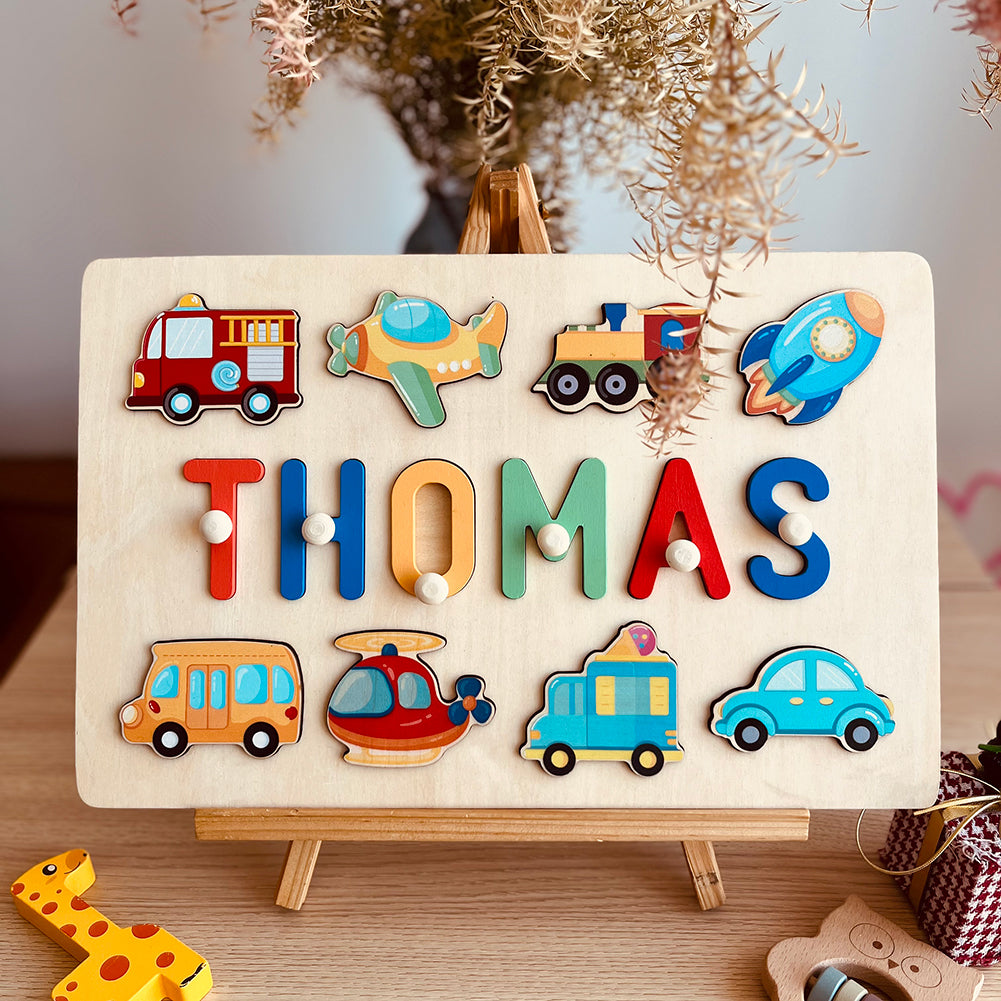
Some letters are naturally tiny — “I,” “l,” “j,” even the dot on an “i” if the puzzle has one. And some puzzles come with little wooden knobs on each letter to make them easier for tiny hands to grab. Those knobs can loosen over time. A determined chewer can absolutely bite one off.
Here’s the test you can do at home (or imagine doing in the store):
The toilet paper roll test.
If any piece — or any piece of a piece — can fit completely inside a standard toilet paper tube, it’s a choking hazard for children under 3. Period.
That includes:
-
A detached knob
-
A tiny letter like “I”
-
Any decorative shape that isn’t firmly attached
Some parents think “supervised play” is enough. And sure, supervision helps. But have you ever blinked while a baby’s hand moves? It takes less than two seconds for something to go from puzzle to mouth to airway.
What about the little knobs on each letter?
Those knobs are useful for toddlers learning to grip. But for a baby who chews, they’re the weakest link. I’ve seen puzzles where the knob is glued into a pre-drilled hole. After a few rounds of aggressive chewing and pulling, that glue fails. Now you have a small wooden peg loose in your baby’s mouth.
If you absolutely want a name puzzle for a child under 2 who chews:
-
Choose one without removable knobs (flat pieces only)
-
Make sure every letter is too large to fit through a toilet paper tube
-
Check the puzzle regularly for loose parts — like, every single time before you hand it over
So, are they safe?
For a baby who puts everything in their mouth? Only if you’re extremely picky.
I’d personally wait until closer to age 2, or stick with puzzles made from a single piece of solid wood with non-toxic paint and zero detachable parts. And even then, I wouldn’t leave them alone with it.
If your baby is a heavy chewer and you really want a name puzzle, consider keeping it as a “lap activity” — you hold the puzzle, you hand them one piece at a time, and the puzzle goes back on a high shelf when you’re done.
Or honestly? Save the personalized puzzle for their second birthday. By then, they’ll still chew sometimes, but they’ll also build and match and learn — and the safety risks drop dramatically.
No puzzle is worth a trip to the ER. And no cute custom letter is worth wondering whether the paint was safe. Trust your gut. If a listing feels vague about materials, move on. There are plenty of safer toys for the mouth-first phase — name puzzles can wait a few months.